

Chapter 3 [[Draft]]
Certainty Betrayed

Chapter 3
Frank
Frank met the hospital’s House Supervisor at the secured door off the main lobby. He showed her his credentials and followed her down a long corridor and through another set of secured doors.
The hospital unit was filled with uniformed state police and the local medical examiner’s team. A photographer was taking pictures with a digital SLR camera.
“Have all the patients been moved off the unit?” he asked the supervisor.
“Yes. They were moved to three different units until you are done with the investigation.”
“I’ll need to speak to them.”
“Which ones?”
“All of them. And any staff that has worked with the suspect since he got here.”
“I will let administration know. They can get you names. But one of the patients was discharged today.”
“I will need his contact information.”
“I’ll ask Social Work to get that for you.”
“How is the staff holding up?”
“I guess about as well as you’d expect. Two co-workers and a patient were killed. Everyone’s scared and pretty upset. Four people called in sick today, and once of our techs quit.”
“Did that tech work on this unit?
“No. But she knew one of the people killed. She was really upset.”
“OK. I probably won’t need to talk to her, but make sure I have her contact information.”
“Of course.”
Frank walked over to the medical examiner.
“Hi Roger. What have you found?”
“Hi Frank. It’s pretty disturbing. Three dead. One appears to have been strangled, another has trauma to the neck, but I can’t tell cause of death yet. The third, the girl, seems to have died from blunt trauma to the head.”
“And the suspect is a patient?”
“That’s your department, my friend. I just figure out cause of death. I’ll have more information after the autopsies.”
Frank turned to one of the uniformed troopers. “Show me the bodies.”
The trooper led him to the ambulance bay and pulled back the drape covering Parker’s body. Frank squatted down and examined the pretty young victim. He noted discoloration to the right side of her face, contrasted by the paleness of her left side. Her eyes were open and the pupils fixed. She was lying semi-propped by the wall with her legs folded under and her left arm resting behind her back. He noted a small amount of blood on the wall below the girl’s head. There was another stain of blood on the shoulder of her white scrub top. Everything he saw concurred with Roger’s assumption of blunt force head trauma. He saw something sticking out from under the victim’s blue scrub bottoms. Frank reached into his pocket for a pen and used it to move the object into the open. It was an ID badge with a photo of the girl smiling in her nurse uniform. He sighed.
Frank stood up with a suppressed groan. His knees weren’t quite as mobile as they were twenty years ago. Carrying an extra 25 pounds or so didn’t help.
“Where are the others,” Frank asked the trooper.
“Down here,” said the trooper, taking the lead down the other hall.
As Frank entered room 109, he couldn’t help thinking of prison cells he had visited. There were no bars, but the institutional feel of the room was so similar to the low security cells upstate. He walked over to the corpse of the victim on the floor.
“Charlie Malinsky. He was a tech here. Kind of like a nurse aid, but for psych patients,” offered the trooper. “The one on the bed is Jeff Brown. He was a patient. The suspect’s roommate.”
Frank examined the victim on the floor. The man’s neck was oddly indented right below the chin. There were no other signs of trauma. The body lay on the floor with arms at the sides and legs straight. There didn’t seem to be signs of struggle.
Moving to the victim on the bed, Frank found the other body in a similar state. There was bruising on the neck, but no other obvious signs of struggle. He looked around the room for weapons, but there were none. The pillow cases were still on the pillows of both beds. The sheets were disarranged, but appropriate for the beds having been slept in.
He walked over to the window. Outside the room was a recreation courtyard with a basketball hoop. It was empty. The sun was just cresting the roof of the building. It looked like it was going to be a nice day outside.
He turned around and surveyed the room. He noted the desks and closet, the bathroom, and the buzzing fluorescent lights. There was a faint chemical smell in the room. Probably some kind of bug spray.
“He killed the roommate first. Apparently no weapon. Maybe used his hands. Same with the one on the floor. We’ll have to wait on the autopsy report.”
He walked over to the door. “Probably jumped the tech from behind the door. I wonder if he could have used a belt.”
“They take belts away,” said the trooper. “Suicide prevention. Just like in the prisons.”
“Makes sense,” Frank replied.
Frank walked back into the hall. “Did anyone see anything?” he asked.
“We’ve interviewed the midnight staff and the patients on the unit. No one seems to have heard or seen anything. The bodies were found at 4am. The patients were all asleep according to staff.”
“I’ll need to talk to the staff that found the bodies.”
“They are in a conference room up front. It’s the midnight house supervisor and a tech.”
“Is anyone pulling video on those?” Frank asked, pointing to a couple of cameras on the ceiling of the corridor.
“Yes. The Risk Manager is getting that ready for you. No cameras in the bedrooms. But there are some at the nursing station and in the ambulance bay.”
“Good. Take me to the conference room.”
The interview with the staff didn’t result in any additional information beyond what Frank had already assessed on his own. The supervisor and tech had been rounding on the units to check on staff when they found the victims at about five minutes after four. Frank ended the interview quickly, understanding that both employees would be traumatized for several days after discovering their co-workers dead. He gathered their contact information and sent them Home.
The Trooper next led him to an administrative hallway with carpeted floors and artwork on the walls. They walked past several doors until the trooper stopped and knocked on a partially open door. A voice on the other side welcomed them to come in. The trooper nodded to Frank, then headed back to the crime scene.
As Frank walked into the room, a fit middle aged man stood up to greet him. “Good morning Detective. Well, I guess maybe not so good. But morning anyway.”
“Good morning,” Frank replied, shaking the man’s hand. “I’m Detective Sergeant Frank Brunson with the State Police. I’m leading the investigation. I assume you’re the Risk Manager for the hospital?”
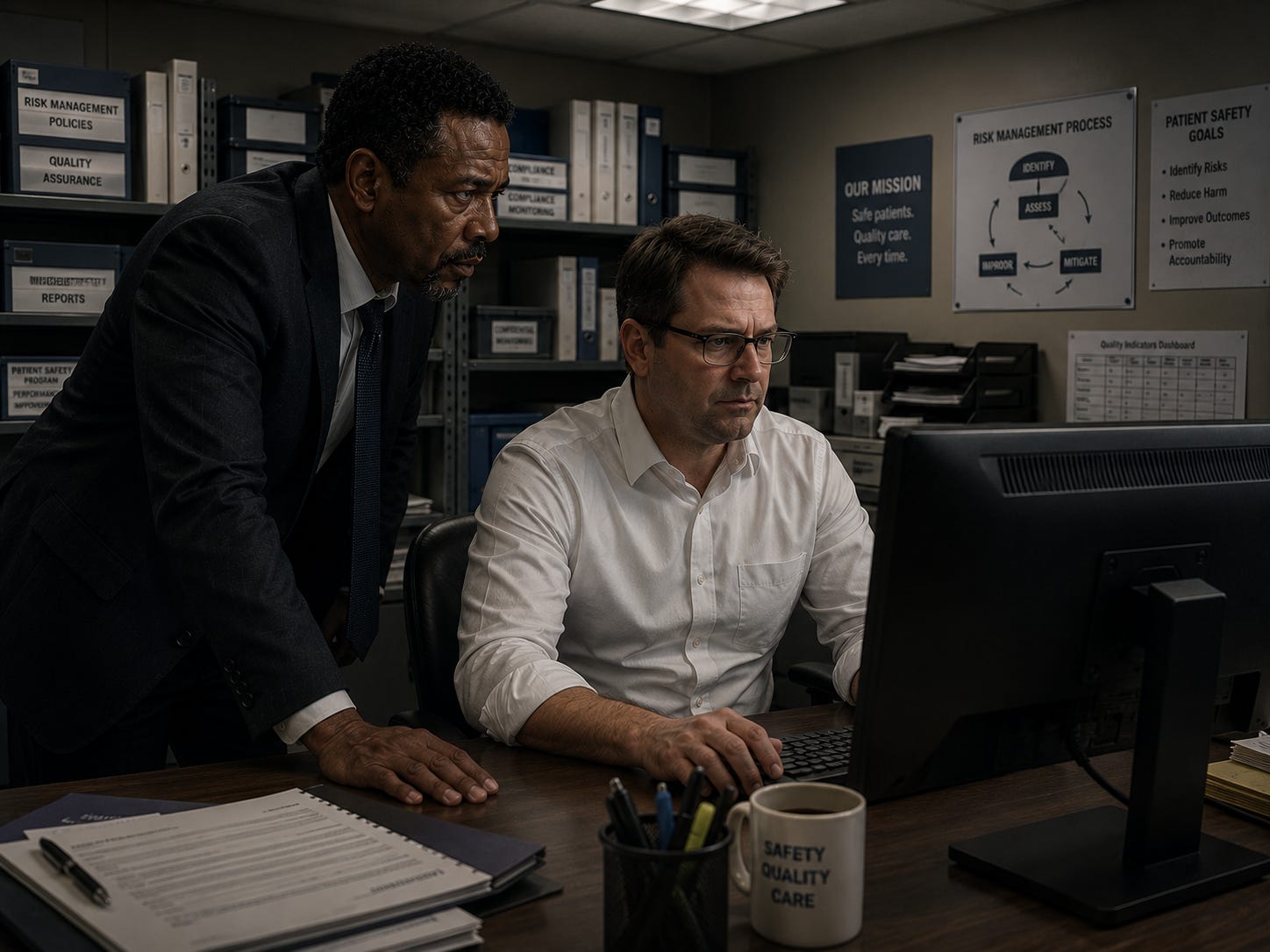
“Yes. Dave LaPierre. Been doing this for about two years, ever since I retired from the Auburn Hills Police Department. I was a detective myself. Miss it sometimes.”
“Excellent. I’m guessing you’ve started investigating things yourself?”
“Yes. Got here about an hour ago. I haven’t been on the scene myself, but I talked to the staff and reviewed the video. Do you want to see it?”
“Please.”
Dave pulled another chair around to his side of the L-shaped desk and sat down in front of his computer, inviting Frank to take it. He sat in his own chair, opened a screen of video thumbnails, and selected one.
“We have cameras throughout the common areas of the hospital. There are no cameras in the patient rooms, physician offices, or the office areas behind the nursing stations. There are windows in the offices though, so we can see in from the hall cameras. The cameras are video only. No sound. There are cameras at each end of the halls looking in both directions. There are additional cameras in the patient common room and at the nursing station.
“This video is from the camera at the hall intersection looking down the hall toward room 109.” Dave clicked “play” and the video started.
Frank watched as the tech Charlie, a clipboard in hand, entered room 108, was out of camera for a few moments, then came back into the hall. He crossed the hall into 109. Frank glanced at the time stamp at the top of the screen. It was exactly 3:23.
“So the second murder happened at 3:23?”
“It appears so. The first murder would have been within 15 minutes prior to that.”
“How do you know that?”
“Nursing staff rounds on patients every 15 minutes. It’s a form of suicide prevention. They observe every patient, documenting what they’re doing and verifying some sign of life.”
“Do you have that documentation?”
“No. I haven’t had any interaction with the crime scene. It’s either still with the victim or one of your guys has it. When I spoke with the House Supervisor, she said she hadn’t touched it and didn’t remember seeing it. But she was pretty shook up.”
“Understood. One second.”
Frank removed his cell phone from his left front pocket and pulled up a number from his contacts list. He dialed the number and held the phone to his ear. “Cranston? Hey. It’s Brunson. There should have been a clipboard and some papers near the body of the tech in room 109. Could you please locate that and bring it to the Risk Manager’s office? Thanks. Please make it quick.
“We’ll have that in a few minutes.”
“Good. Want to see more video?” Frank nodded and Dave clicked the screen. The video continued with no action for another five minutes. Then Frank watched as a tall, medium build white man with dark curly hair, wearing sweat pants, a gray tee shirt, and white sneakers exited room 109. The made a quick scan of the hallway, then crossed from the room to the nearby closet. He used a key to open the closet, moved something inside, then removed a medium sized plastic bag. He re-locked the closet then returned to the patient room.
“That looks like a locked door, right? Where did he get a key?”
“I’m guessing it’s Charlie’s key. Did you see how quick he was? He knew exactly what he was doing.”
“Hmmm… There’s more?”
“Yes.” Dave pulled up a video from another angle. “This is the camera right outside the room looking up the hall. You can only see part of the doorway to 109, but it lets you see the hall from the other direction.”
As Frank watched, he saw movement coming from the partial doorway. The tall white man exited room 109 and headed up the hall. The time stamp showed 3:29.
The figure crossed the hall and stayed to the right side, moving quickly with an economy of movement.
“Look at him move,” said Frank. Does this guy have a military background?
“It’s not in his records if he does. He’s been a psych patient for about 15 years. He was 18 when he was diagnosed. I doubt he ever served.”
“Diagnosed with what?”
Dave pulled out a file thick with loose papers. He shuffled through, finally finding the page he wanted. “Schizophrenia, Paranoid Type,” he read from the page, “Appears groomed and unusually well organized for the condition. Patient reports auditory hallucinations and exhibits significant paranoia and hypervigilance. Patient is highly intelligent and displays an unusual ability to mask his delusions and control disease related behaviors.”
“Schizophrenia. That’s like when you have a bunch of personalities, right?”
“No. That’s Hollywood. The doc can explain it better, but schizophrenics just live in their own world. They sometimes have delusions of people being out to get them. They hear voices or see things. They get so distracted by the disease that can’t function in society. But they don’t have multiple personalities.”
“OK. Never really studied mental health.”
“I hadn’t either until I came here.”
“What’s next?”
Dave clicked another video. “This is the camera over the nursing station. You can see Parker in the upper right sitting at the desk.”
As the video played, frank watched the suspect enter the frame from the lower right, cross to the office door which he noted was wide open. “Why is the door open?” he asked.
Dave paused the video. “That’s normal. We don’t take known violent patients on this unit.”
“Sitting with her back to an open door. Doesn’t seem very secure.”
“Yeah. I’ve pointed that out before. But nursing ignored the advice.”
“I’m guessing they’ll make some changes now.”
“You’d think. But I wouldn’t bet on it, unfortunately.” Frank stared at Dave who simply shrugged. “We’ll see.”
Dave continued the video. The suspect moved up quickly behind his victim and placed his right hand at her neck while slapping his left over her mouth. They watched as he spoke to the victim, then walked her to the ambulance bay door. Frank noted the plastic bag from the closet dangling from the suspect’s right wrist.
“Is he holding her throat?” Frank asked?
“I can’t tell,” Dave replied.
A knock on the door surprised both men. Dave paused the video as Trooper Cranston came in holding the requested clipboard. “Here you go Frank. Do you need anything else right now?”
“Not at the moment, but thanks. Anything new from the scene?”
“I don’t think so. We’re just wrapping up. The ME is moving the bodies.”
“Hey Trooper?” said Dave. “Do you think you could locate the suspect’s chart on the unit? His name is James O’Loughlin.”
The trooper looked over to Frank, who nodded his consent. “Yeah. Just give me a few.” The trooper left the room, closing the door behind him.
“Do you mind cracking that door a bit?” Dave asked Frank? “It gets really hot in here with the door closed.
Frank walked around the desk and cracked the door open a few inches before returning to watch the videos.
The two men watched the suspect remove something from his pocket and hold it to the door frame, then open the door.
“Badge reader?”
“Yes.” Dave switched to a different video. “This is inside the anteroom.”
The suspect pushed his victim through the doorway and into the anteroom. They crossed the room and the suspect pulled something from the front of the woman’s shirt. He waved the object over the keypad at the exit door, then said something to the woman. The woman reached up and typed numbers into the keypad. The suspect opened the door and blocked it with his foot. In a sudden movement, the suspect placed his hand against left side of the woman’s head and violently slammed it against the cinder block wall. The woman slumped to the floor and the suspect moved through the door. Once in the ambulance bay, he used one of the badges to open the side door and continued into the parking lot.
Dave switched videos again, to one overlooking the parking lot. They watched as the suspect located an older model light blue compact sedan, entered the car, and began to drive. The car made a right turn out of the parking lot and continued out of view.
“What do you think?” Dave asked, leaning back in his chair and looking toward the other man.
“I think I’ve seen too many movies.” Frank replied. “This guy doesn’t act like a Hollywood psycho-killer. He’s efficient, methodical, and skilled. No unnecessary movements. The kills all appear to be quick and effective. He obviously planned the escape in detail and executed the plan without any significant error. Is this normal for a psych patient?”
“Not really. Or at least not in my experience. I’m guessing the doc can explain that better. But usually, they’re disorganized and withdrawn. They keep to themselves and only get violent when they feel threatened.”
“Are you sure he’s schizophrenic?”
“Again, a question for the doc. But he has a history of the disease and was admitted for the same symptoms he’s had in the past. At least according to the intake paperwork. We’ll have to check the chart when that trooper comes back. Or ask the doc.”
“When will the doc be here?”
“He’s at another hospital right now. We expect him later this morning.”
“Ok. What are your thoughts?”
“I don’t know. He’s not behaving like a typical schizophrenic. But the old charts say he’s really smart and disciplined. I just can’t figure out how he learned to move that way. Or to kill so efficiently. I agree he looks military trained, but there’s no record of it.”
They were interrupted by another knock at the door. Trooper Cranston entered without waiting for a reply. “Here’s that chart.” he said, placing the requested binder on the desk. “We’re done collecting evidence and about the leave the scene. We’re leaving it taped off and have instructed the House supervisor to keep people out until we give them the all-clear.”
“Thanks Cranston. I’ll stick around until a have a chance to talk to the suspect’s doctor. But I don’t think I need anything else from the scene right now.”
“Ok. Just give a call if you need anything else. I’m going to head back to the Post and start my report.
“Sounds good. I should be all set.”
“See you later then.”
“Take care Cranston. Say hi to Ashleigh and the kids for me.”
“Will do.”
“Good guy.” Frank said to Dave as the trooper left the room. Been with us for about three years. He’s a gun guy. Really good on the range. Down to earth too. No ego. Just a really good cop. He and I go to the same church.
“My kind of guy.” said Dave.
With Dave as his guide, Frank toured the hospital, learning the layout and the hospital routine. He spoke with Social Work, Dietary, and various staff in an attempt to create a profile of the suspect. All agreed that James O’Loughlin was a quiet but polite and cooperative man in his early thirties. He had shown no signs of violence during his stay. One tech had worked with the suspect at another facility during two previous admissions. He said James had always been calm and polite, even when extremely delusional. He couldn’t believe the man had become violent. It was out of character.
Several staff reported the suspect had been hypervigilant during his stay, but that this was common with paranoid schizophrenia. The chart had noted several times that James had been observed watching doors and cameras, also not uncommon with schizophrenia.
At a little after 9:00, Dr. Thomas Nguyen arrived to the hospital. Dave led to Frank meet him in the hospital conference room.
“Good morning Dr. Nguyen.” Said Dave as he entered the room and introduced him to the detective. “Detective Brunson, I’ll hand it over to you.” Dave sat in one of the chairs across from the doctor and Frank chose the chair next to him.
“Thanks Dave. Dr Nguyen, could you please tell me about your patient James O’Loughlin?”
“Certainly, Detective.
“I’ve cared for James for almost 15 years. I first met him when he was 18 years old. He was admitted to my care at a different facility for a psychotic break probably triggered by his use of marijuana at a party.”
“Does marijuana cause schizophrenia?” asked Frank.
“No, but if someone is at risk, it’s been observed that the use of marijuana is sometimes associated with the onset of psychotic symptoms. The paranoia people experience with marijuana is a type of delusion seen in schizophrenia. Studies support the suspicion that the drug triggers earlier onset and increased symptoms.”
“Does James still smoke Marijuana?”
“Not that I’m aware of. He denies it when asked. James is very intelligent and understands his diagnosis very well. He is a bit unusual in that he tends to be compliant with treatment and avoids anything that will exacerbate his symptoms. This is his seventh admission for acute psychosis. Each of the previous episodes have been due to the decreased effectiveness of his medication regimen. Med changes have been highly effective. He lives with his parents and works with a local charity as a volunteer. Of all my schizophrenic patients, he’s among the ones I have always worried about the least.”
“Then what happened today?”
“I’m not sure. This event is completely out of character. James is highly disciplined and controls his schizophrenia extremely well. Even during an intense episode of psychosis, he can control the delusions well enough that most people wouldn’t notice he was struggling. When I met with him yesterday, I could tell he was experiencing symptoms, but only because I’ve known him for years and knew what to look for.”
“Some of the staff said he was watching doors and cameras.”
“Yes. He can’t control it all the time. But when he’s being assessed or interacting with others, he fakes it well enough to fool most people.”
“Did you adjust his medications?”
“Not yet. During a psychotic episode, schizophrenics often refuse meds. We have to get a court order to force them to resume treatment. James was scheduled for court this afternoon.”
“I wonder why he didn’t try to escape on the way to court.”
“Court is done by video in one of the offices here at the hospital.”
“I see. And James knew he would be forced to take medications after this hearing?”
“Yes. He’s familiar with the process.”
“If the meds have worked in the past, why would he have refused? And why would he be afraid of a cour order?”
“This is common. During a psychotic episode, patients are less capable of making rational decisions. They develop delusions of paranoia and persecution. In James’ case, he becomes convinced that the people around him aren’t really people. They are some form of evil incarnate faking kindness and generosity. He also experiences clear auditory hallucinations that validate these fears.”
“Clear voices?”
“Yes. Some patients only hear vague noises, kind of like the mumbled sounds of a crowd in another room. James hears clear, distinct voices that direct his perceptions and behaviors. He’s usually good at ignoring them, but it looks like his disease process has advanced to a level that he can no longer do that.”
“In your opinion, is he someone who is prone to violence or aggressive behavior?”
“No. Quite the opposite. His father was former military and raised James and his brother to be prepared for violence. He enrolled them in Karate as children and encouraged them both to join the wrestling team in school. According to James, his brother liked it, but James did not. He participated for a few years but dropped them both before he finished high school.
“So he’s never been in the military?”
“No. He went to college right after high school but dropped out in his first semester because of his initial psychotic break.”
“I understand. Do you have any opinion on why he would become violent now?”
“Without assessing him, I can’t know for sure, but I suspect his psychosis has advanced. After two days without medication, it’s possible the paranoia had increased to the point that he can’t distinguish it from reality. He’s probably hearing voices again as well. The voices will encourage him to act on the paranoia.”
“You’re painting a very different picture of what I expected. It sounds like this is a normally decent young man who’s fighting against something and losing.”
“That’s about it. What you’ve seen here is not really James. It’s the disease.”
Frank sat and pondered what he had just been told. He was having trouble reconciling the decent, kind man described by the doctor with the violent suspect he had watched beat a young woman to death in the security video.
“Do you think he’ll kill again?
“Possibly. But please understand. I don’t believe James wants to hurt people. I think he’s responding to the delusions. He will do anything necessary to protect himself from perceived threats. And right now everything is a threat. He may also hurt people if he sees them as obstacles when trying to flee a threat. He’s dangerous, for sure. But he’s not malicious.”
“I’m not sure that matters to his victims.” Frank responded.
After the interview, Frank followed Dave back to his office.
“I think I’m done here for now. Please leave the crime scene intact until you hear from us. Also, I’m going to need authentic copies of all of the patient records for O’Loughlin and the patient he killed.”
“I’m already having those copies made.” Said Dave. “They should be ready this afternoon.”
“Good. I’ll send a trooper over to pick them up. Just call when they’re ready.”
Frank handed Dave his business card, shook his hand, and headed back to the Post.